
Phonetics is an Amazing Shower Thought
Not sure if anyone can relate to this, but I love to spend time thinking about how sounds are made.
For example, last night in the shower I was thinking about how the sound of ‘j’ is pronounced. I was trying to break the sound up into parts, and it sounded like it could be produced by combining a ‘ch’ with an ‘uh.’
Some other recent shower discoveries:
- Vowels are grouped by themselves because pronouncing them doesn’t involve any parts of your mouth touching (as with your lips in ‘b’) or the release of pressure (as in ‘k’).
- The long ‘o’ sound, found in words like “bone” and “phonetics,” is created with an ‘uh’ followed by an ‘oo.’
- Three of the long vowel sounds, ‘a’, ‘e’, and ‘i’, end in a long ‘e’ sound, while the other two, ‘o’ and ‘u’, end in an ‘oo.’
- The ‘ch’ and ‘sh’ sounds both end in the exact same way. The only difference is that the ‘ch’ sound starts with a very slight ‘t.’
Try these for yourself.
This area of phonetics is called articulatory phonetics, and this was my absolute favorite part of taking Intro to Linguistics my sophomore year at Tufts. If I could go back to Tufts or decided to stay for an eighth semester, I would definitely take more linguistics courses because they’re so much fun. At the surface, articulatory phonetics seems pretty straightforward, but there is so much that goes into the words and sounds that most people don’t pay any mind to.
Enter: the International Phonetic Alphabet (IPA)
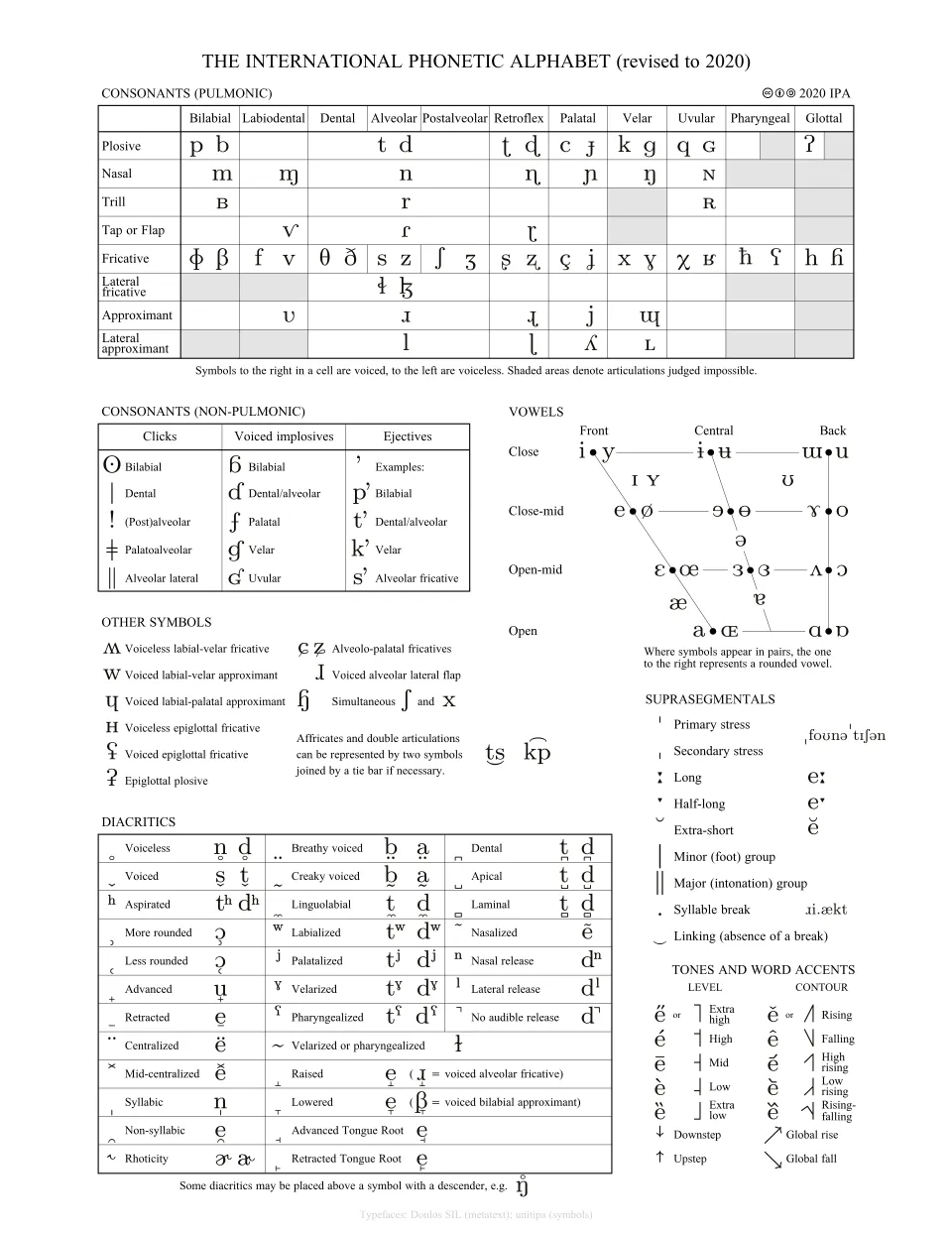
The IPA includes essentially every sound that humans can make with their mouths across all languages (excluding sign languages). If you’ve ever heard of South African languages that include mouth clicks in their repertoire, don’t worry — the IPA includes those sounds too. You’ve probably have seen IPA pronunciations when looking up a word online or in a dictionary. Usually, it will be right beside the word.
So, after my shower, I decided to look into the ‘j’ sound in the IPA. It’s depicted as either /ʒ/ or /dʒ/ in the IPA, which are what’s called a fricative and affricate, respectively (I remember learning about these in Intro to Linguistics!). A fricative is a sound involving friction created by air flowing through a narrow gap in the mouth, and an affricate is a fricative combined with a stop, which is a sound created by a blockage of air.
Interesting.
This made sense compared to what I came up with in the shower, as a ‘ch’ sound creates the narrow gap in your mouth and the ‘uh’ sound produces the vibration. Weird how /ʒ/ exists as the smallest component in the IPA, though, as it can clearly be broken up further.
What didn’t initially make sense was the discrepancy between /ʒ/ and /dʒ/. It turns out that there are some contexts where ‘j’ sounds are preceded by a ‘d’ stop sound and other contexts where they’re not. Examples of each scenario:
/ʒ/
- “measure”
- “pleasure”
- “garage”
/dʒ/
- “jam”
- “gradual”
- “advantage”
This is the exact same difference as seen in the ‘ch’ sound and the ‘sh’ sound, except with the ‘t’ stop sound. In the IPA, ‘ch’ and ‘sh’ are written as /tʃ/ and /ʃ/, respectively, and are also fricative and affricate sounds. *Gasp*
This is such a good example for why phonetics is so interesting to me. The components that make up all of the words we use in conversation are so intricate and objective. I feel like I could infinitely think about different words and sounds and would still be able to have new revelations.
I truly encourage you, the next time you’re not doing anything or are in the shower, to try to think about certain letters and words and to break them up, define them, and categorize their sounds.